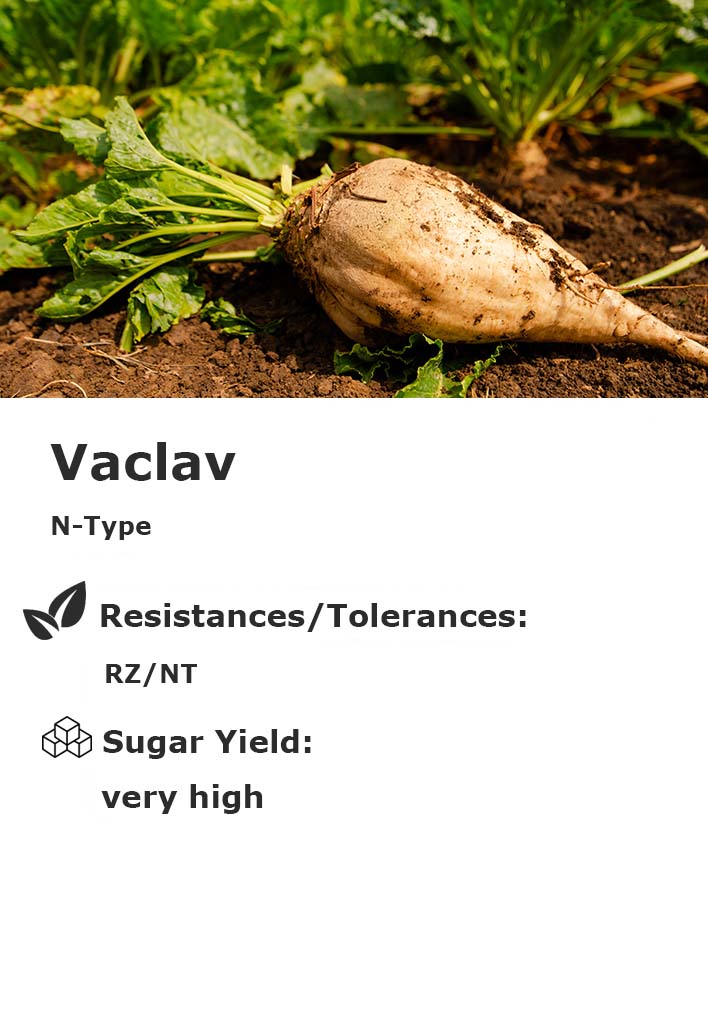
Vaclav is another variety of sugar beet that is commonly bred for high yield and disease resistance, and it is also often associated with the breeding programs of major seed companies, like Strube. While there’s less detailed public information about Vaclav specifically (compared to more widely known varieties), we can deduce some of its likely characteristics based on the general attributes of similar varieties produced by Strube and other major breeders.
Here are some of the typical traits you’d expect from the Vaclav sugar beet variety:
Key Characteristics of Vaclav Sugar Beet:
High Sugar Content
Like many modern sugar beet varieties, Vaclav is likely to have a high sucrose content. The goal of breeding is to maximize sugar extraction per hectare, which is critical for commercial sugar production and bioethanol production.
Sucrose Yield: High sugar content allows farmers to extract more sugar from each root, making it an efficient crop for sugar processors.
Disease Resistance
Rhizomania Resistance: This is a common feature in modern sugar beet varieties, and Vaclav is likely to have strong resistance to rhizomania, a viral disease that can significantly reduce yield if not controlled.
Fungal and Bacterial Resistance: Similar to other high-performance varieties, Vaclav likely has good resistance to common fungal infections such as Fusarium and Alternaria, and might also offer some level of resistance to bacterial diseases.
Strong Root Development
Good Root Size: The variety is likely to produce large roots, which are important for both the sugar content and overall yield. Larger roots typically result in higher tonnage, which is crucial for profitability.
Root Shape and Quality: The roots of Vaclav are likely to be well-formed, with a smooth surface that can make harvesting easier and minimize damage.
Adaptability to Various Growing Conditions
Wide Climatic Adaptation: Like many varieties bred by Strube, Vaclav is expected to be adaptable to various climatic conditions. This would make it suitable for a range of regions, from cooler, northern climates to more temperate zones.
Drought Resistance: In addition to being adaptable to temperature, Vaclav might be designed with some tolerance to drought, especially in regions with variable water availability.
Disease Tolerance and Agronomic Traits
Standability: Vaclav may have strong standability, which means it is less likely to lodge (fall over) as the crop matures. This is important for efficient harvesting and reducing crop losses.
Leaf Spot Resistance: Like other high-quality varieties, Vaclav may show good resistance to leaf diseases like Cercospora or Powdery Mildew, which can be problematic in humid conditions.
Efficient Fertilizer Use
Nutrient Efficiency: Similar to other modern sugar beet varieties, Vaclav would likely be bred for better nutrient efficiency, which means it can make better use of available soil nutrients, reducing the need for high fertilizer inputs.
Harvesting Efficiency
Mature Evenly: Many modern varieties, including Vaclav, are designed to mature more uniformly. This ensures that the entire crop is ready for harvest at the same time, which can help optimize harvest efficiency.
Smooth Roots: Roots that are smooth and less irregular help ensure that the harvesting process is smoother and the roots are less damaged during digging.
Yield Potential
High Root and Sugar Yield: Like other top-performing varieties, Vaclav is likely bred for high root yield (tonnage per hectare) as well as high sugar yield per root. This combination helps growers achieve better profitability.
Summary of Vaclav’s Likely Features:
High sugar content for increased sucrose yield.
Strong disease resistance, including resistance to rhizomania, Fusarium, and other common beet diseases.
Large, healthy roots with a smooth surface, facilitating easy harvesting.
Adaptable to different climates, with good resistance to drought and colder growing conditions.
High yield potential in terms of both root mass and sugar content.
Nutrient-efficient, requiring less fertilizer input compared to some other varieties.